
Ontonagon Projected Versus Actual Release
A projected date is a calculation or eligibility point. An actual release date records what happened. In an MDOC record, the Earliest Release Date is generally when the Parole Board first obtains jurisdiction on an indeterminate sentence. The prisoner does not have a right to leave on that day. The Maximum Discharge Date is the point at which MDOC cannot keep the person on that sentence, subject to the lawful calculation, another sentence, or a hold. Date Paroled is the field that shows the actual prison release into parole status.
County custody uses a different record. The Ontonagon County Jail can hold pretrial detainees, county-sentenced inmates, and people waiting for another authority. A pretrial detainee has no sentence end date. Bond, a dismissal, a court order, a plea or sentence, and any detainer can change custody. For a county sentence, the Sheriff and the sentencing court are the sound sources for the calculation and release event.
Find Ontonagon Projected Release Dates
Identify the custody system before searching. OTIS excludes county jail and city lockup inmates, people serving only a jail sentence, and some other records. It is appropriate for an Ontonagon felony case that led to an MDOC prison sentence, parole, or felony probation. The Sheriff and local court handle a county jail sentence. Federal and immigration custody use separate federal systems.
- Determine whether the person is at the Ontonagon County Jail, in MDOC custody, or held by another authority. A transfer out of the jail is not community release.
- For MDOC, open OTIS and use the MDOC number when known. Otherwise search the exact name and narrow only as needed.
- Match date of birth, aliases, physical description, sentencing county, court file number, and offense. Do not rely on a name alone.
- Read Earliest Release Date, Maximum Discharge Date, current status, location, and Date Paroled together. A prison location means the person remains incarcerated.
- For a county sentence, call the Ontonagon County Jail and inspect the sentencing order in MiCOURT. Ask how jail credit and statutory good time apply to that judgment.
- Confirm the completed event through the release record or status. The Ontonagon released inmate search path explains the full jail, court, MI-VINE, and OTIS sequence.
OTIS may remove routine discharged records after three years. If a state case is older, request the judgment from the sentencing court or the time computation and discharge record from MDOC.
A local court search must also use the right Ontonagon court. The 98th District Court handles misdemeanors and the early stages of felony cases, including many bond events. The 32nd Circuit Court handles felony adjudication and sentencing. In MiCOURT, compare the case number, charge, register of actions, judgment, bond changes, and recent orders. A bond entry may explain why a pretrial detainee left jail, yet it does not create a projected sentence-release date.
Ontonagon Jail Good-Time Credit
Michigan law does not supply one percentage for every sentence. For an eligible, rule-compliant county jail prisoner, MCL 51.282 provides one day of sentence reduction for each six days served. The sheriff administers county jail good time. The rule does not let a reader calculate a firm release date from a sentence headline because prior jail credit, the exact judgment, conduct, holds, and concurrent or consecutive terms can all matter.
The official statute page preserves the rule used for an Ontonagon County jail sentence:
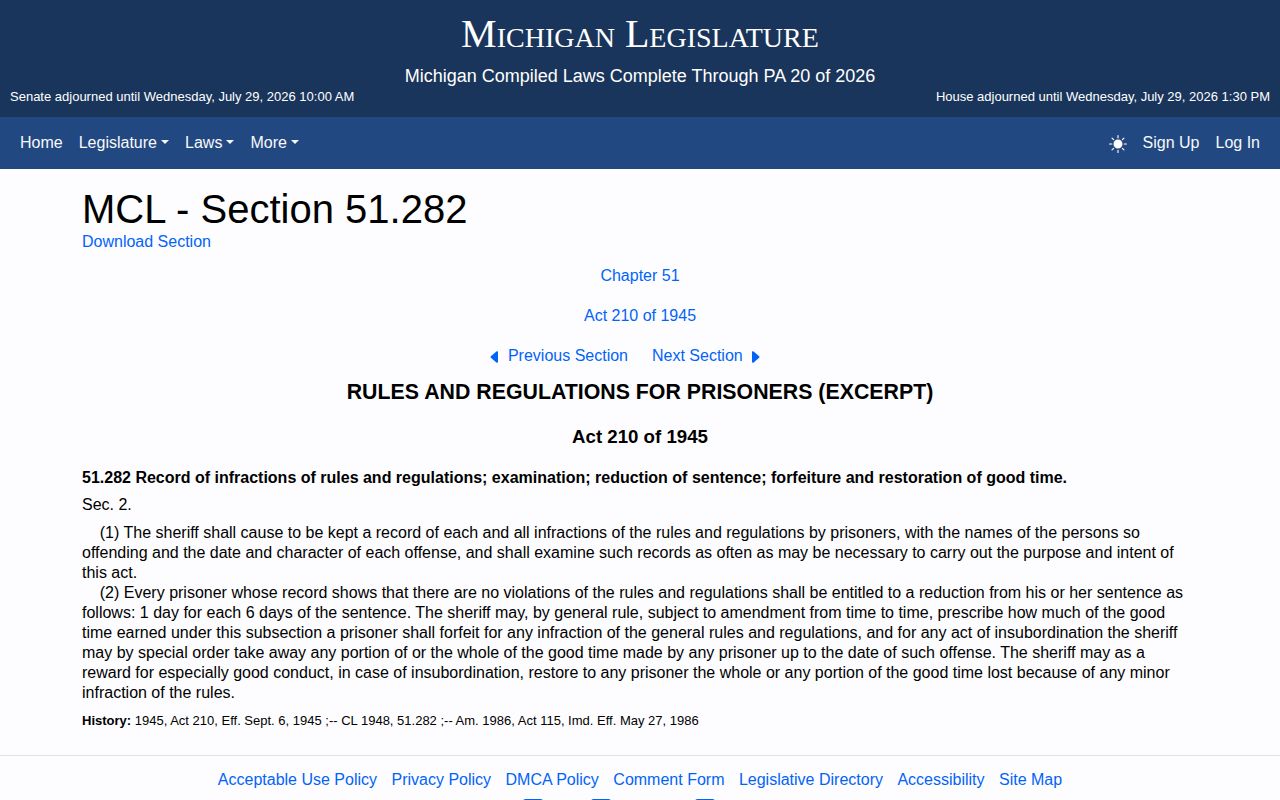
The captured law is a source for the one-for-six framework, not a release-date calculator. Ask the jail how it applies to the named sentence.
MDOC prison time works differently. Michigan truth in sentencing requires affected prisoners to serve the full minimum term before parole consideration. It is not an “85 percent” rule. A person can reach the minimum and still remain in prison if parole is denied, deferred, or not yet processed. A maximum sentence and any other lawful hold remain important.
Note: County jail good time and state prison parole eligibility are separate frameworks and cannot be swapped in one date calculation.
Ontonagon OTIS Release Fields
OTIS presents several date and status fields because Michigan commonly uses indeterminate sentences with a minimum and maximum term. The fields answer distinct questions. A correct reading starts with the current status and location, then compares the date labels.
| OTIS field | What it means |
|---|---|
| Earliest Release Date | The usual first point of Parole Board jurisdiction, not guaranteed release |
| Maximum Discharge Date | The calculated end of MDOC authority on that sentence, subject to other lawful custody |
| Date Paroled | The actual date the person left prison or acquired parolee status |
| Status | Whether the record identifies a prisoner, parolee, probationer, discharged person, or another reported status |
| Location | The prison or community supervision office tied to the current MDOC record |
The MDOC OTIS information page explains who appears and who does not:
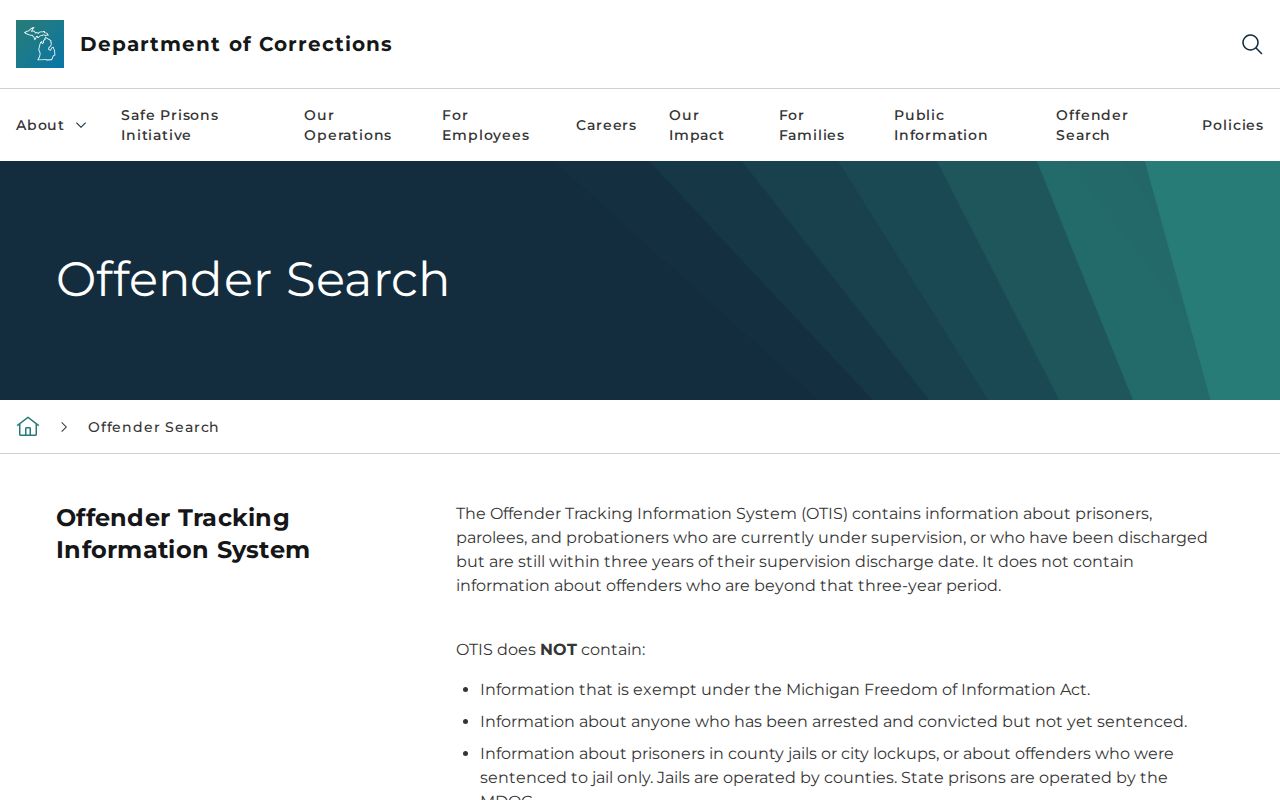
The coverage limits explain why a jail-only Ontonagon case will not appear, even when the county has a valid custody and release record.
Why Ontonagon Release Dates Change
A displayed or expected date can move because the legal and administrative inputs change. An earliest date that passes without release is not, by itself, an error. The next check should be the current status, the Parole Board action when applicable, and any other sentence or hold.
| Factor | Possible effect |
|---|---|
| Corrected judgment or resentencing | Changes the term, credit, or relationship between sentences |
| Jail or prison credit | Award, loss, restoration, or recalculation can change the expected date |
| Parole decision | A grant allows processing; denial, deferral, or rescission means no release at that point |
| Detainer or other case | Can cause transfer to another authority rather than community release |
| Violation or return to custody | Can interrupt community status and require a new official review |
| Appeal, set-aside, or commutation | Can change the legal authority or public record |
A detainer means another authority asks that custody continue or that the person be handed over. The Ontonagon Jail may record a transfer while the person remains confined elsewhere. Always ask for the receiving agency when the disposition is “transferred.”
Concurrent and consecutive sentences also matter. Concurrent terms run at the same time to the extent ordered. Consecutive terms run one after another as the judgment and law require. A public-facing date cannot be rebuilt safely without the full sentence relationship and official credit. MDOC’s time computation record, sometimes documented within the institutional record packet, is better evidence than an informal subtraction from the maximum term.
Court correction can change the public calculation. OTIS information drawn from the judgment should be corrected first through the sentencing court when the source judgment is wrong. A supervision-location or absconder issue goes to the listed field office. MDOC can then update public information when directed by the court or supervising agent.
Confirm Ontonagon Inmate Release Dates
A projected date should be followed by an actual-event source. For a county detainee, MI-VINE can supply a time-sensitive status change when the participating jail reports it. Call the Sheriff to learn whether the last event was community release, bond, sentence completion, or transfer. MiCOURT can then show the bond order, dismissal, sentence, or other court action behind the event. A narrow written request provides the durable release timestamp and disposition.
For a state prisoner, Date Paroled and a parolee status show that prison release occurred. A discharged status shows MDOC jurisdiction ended. General VINELink registration does not replace OTIS, and expanded state-prison victim notices require separate registration with MDOC Crime Victims Services. The VINELink Release Check gives the person-specific notification steps.
Federal custody is outside OTIS and MI-VINE’s authoritative scope. Use the BOP locator for a sentenced federal inmate. An immigration transfer uses the ICE locator. Keep each system tied to the authority that created the record.
When the Sheriff will not confirm a full disposition by phone, request the booking and release sheet for a named event. Include the person’s full name, date of birth when known, booking or case number, and a bounded date range. Ask for the release timestamp, release type, authorizing order, and receiving agency if transferred. That document confirms what the projected date alone cannot.
Michigan Truth in Sentencing
Ontonagon county jail time and MDOC prison time must not be blended. The state’s truth-in-sentencing explanation states that covered prison terms require service of the entire minimum before parole consideration:
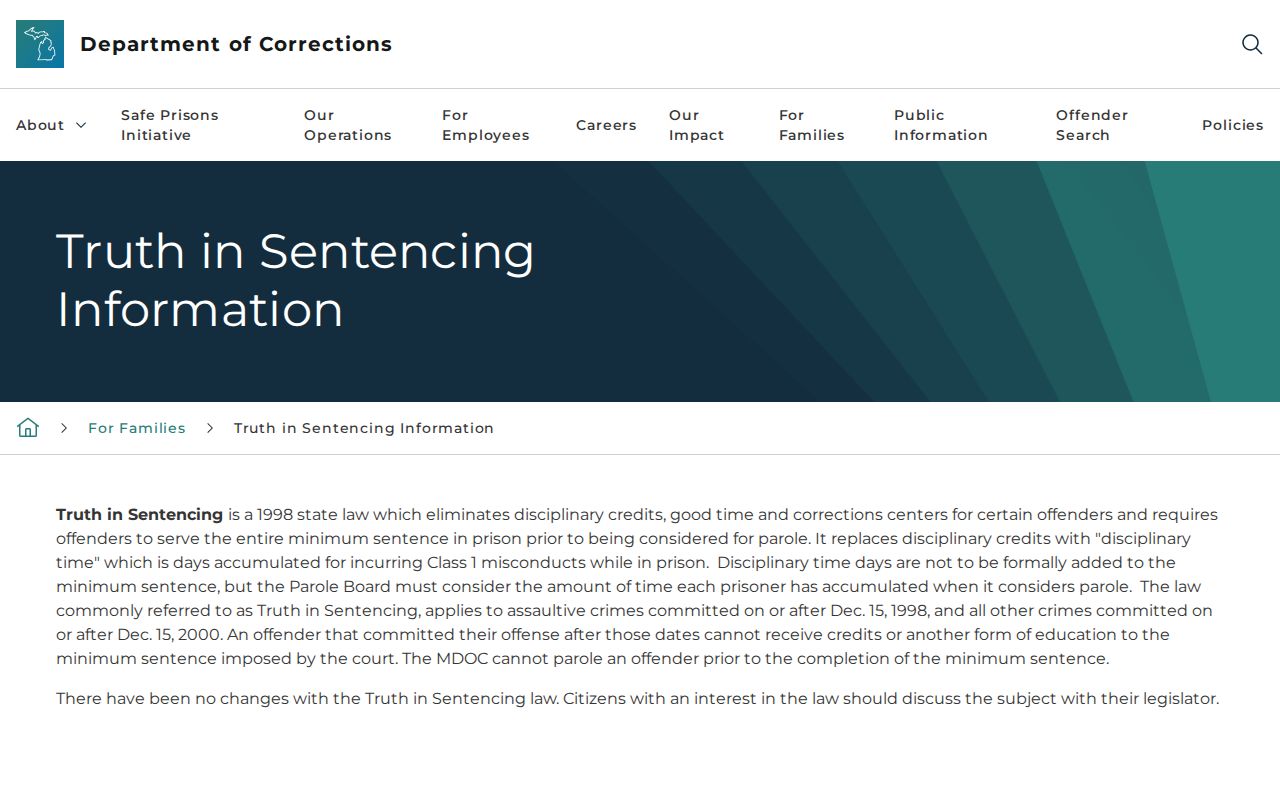
The image supports the full-minimum rule. It does not predict whether or when the Parole Board will grant release after jurisdiction begins.
No researched Ontonagon policy or Michigan statute promises an automatic Friday release when a county sentence ends on a weekend or holiday. Ask the jail how it applies the judgment and county good-time statute to the particular term. Do not subtract days on an unofficial calculator. Missing holds, credit, or sentence relationships can make that result wrong.
The Parole Board has separate legal authority. MCL 791.234 governs jurisdiction and eligibility across sentence categories, while MCL 791.233 provides the release standard. Some life terms and statutory exclusions do not use the ordinary path, and special rules can apply by offense date or sentence type. For those records, quote OTIS and the judgment. Do not derive eligibility from a short general rule.
A favorable Board step still requires release processing, suitable placement when applicable, and resolution of other lawful holds before departure.
Note: An Earliest Release Date may pass while a person remains a prisoner, since parole consideration is not the same event as release.