
Ontonagon VINELink Release Coverage
Michigan VINE, also called MI-VINE, is the state custody and court-event notification service. The official Michigan VINE page describes free access through VINELink, the mobile app, and the telephone service. Participating sheriffs, prosecutors, corrections agencies, and related partners report information to the service. A user can search a person and register for events such as release, transfer, escape, court hearing, or case disposition when those events are offered for the matched record.
For Ontonagon County Jail custody, MI-VINE is the most useful public near-real-time status channel because the Sheriff does not publish a web roster or recent-release feed. It is still a reporting service, not the Sheriff’s certified release sheet. A result should be tied to the correct identity and facility. If the status changes to released, call the jail when the destination is unclear.
The VINELink Michigan entry is the correct starting screen for the person-specific search.
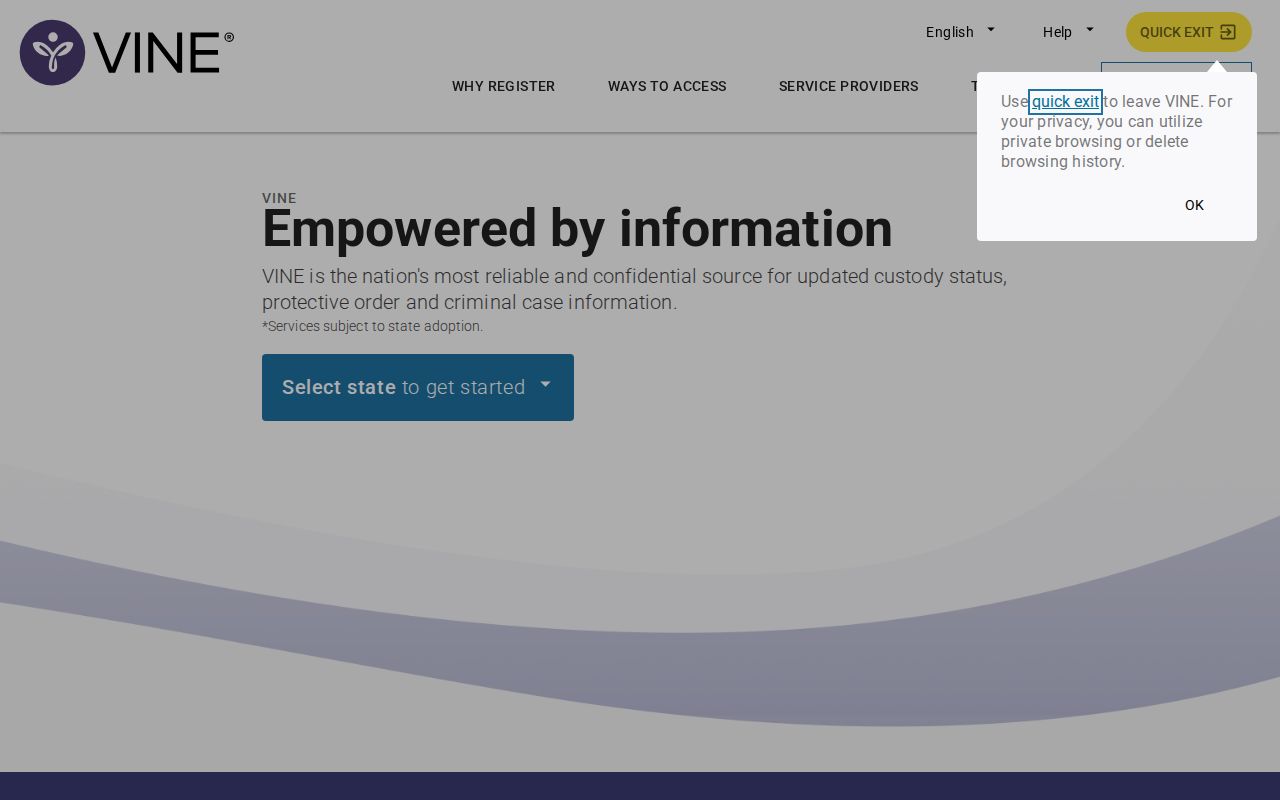
The search screen begins the match and alert process; it does not display a countywide list of everyone released.
Search Ontonagon VINELink Records
Use the legal name first. If the interface returns several people, compare every identifier offered before opening a record. A documented alias can help after the primary search, but a similar name alone is not identity proof. The reporting facility and identification number are often more useful than the name by itself.
- Open VINELink and select Michigan.
- Choose the offender or custody search rather than the service-provider directory.
- Enter the person’s legal name and any available identifier. Try a known alias only if the legal-name search fails.
- Compare age or date of birth, identification number, facility, and other displayed details across all candidates.
- Open the matched record and write down the exact custody status, reporting agency, and event date or time when shown.
- If the record says released, call the Ontonagon County Jail to ask whether the event was community release or transfer.
- Use MiCOURT to check the bond, dismissal, sentence, or order linked to the custody change.
A released status can establish that the reporting system changed that custody record to release-related language. It cannot prove that all charges ended, supervision ended, or no other authority assumed custody. Preserve the record’s booking or case identifiers so the Sheriff or court clerk can locate the same event.
The broader Ontonagon County released inmate search covers the official court, MDOC, federal, and written-record paths when VINELink alone cannot resolve the person’s status.
Note: Search results should be matched with more than a name before any status is attributed to a specific person.
Ontonagon VINELink Release Fields
The fields shown can vary by agency and person. MI-VINE results ordinarily identify the person, reporting agency or facility, custody status, and available event details. Not every record displays the same identifier or event history, so missing fields should not be guessed.
| VINELink field | How to read it |
|---|---|
| Name and identifier | Start the identity match, then compare other displayed facts. |
| Reporting agency or facility | Shows which custody system supplied the status. |
| Custody status | States the agency’s current reported custody category. |
| Event date or time | Places the reported release, transfer, or other change in time when available. |
| Notification options | Lists the delivery channels offered for that record. |
The reporting agency controls the meaning. An Ontonagon County Jail result concerns local custody. An MDOC record concerns state prison or supervision. Federal Bureau of Prisons custody is outside Michigan VINE’s authority. A person can also leave the county jail on a transfer, which ends that local custody event without placing the person in the community.
- Released
- The reporting custody record reflects a release-related change; verify the disposition when another agency may be involved.
- Transferred
- The person left one facility for another authority or location and may remain detained.
- Parole
- A state prisoner has left secure prison but remains under MDOC community supervision.
- Discharge
- The applicable MDOC sentence or supervision has ended.
Register Ontonagon Release Notifications
Register only after confirming the correct person. An alert attached to the wrong record can create needless confusion. MI-VINE may offer telephone, text, email, mobile app, or TTY delivery. The options shown for the matched record control what can be selected.
- Open the correctly matched person record and choose its registration or notification option.
- Select each available channel needed, such as telephone, text, email, app, or TTY.
- Enter the contact details and complete any verification requested by the current interface.
- For telephone calls, create a four-digit PIN and store it privately. Avoid a switchboard because the listener must enter that PIN.
- When the automated call arrives, listen to the message and enter the PIN followed by the pound sign to confirm receipt.
- Update the registration whenever a phone number or email address changes.
If a telephone event is not acknowledged, the official brochure says VINE may keep calling for up to 24 hours. A forgotten PIN can be addressed by calling MI-VINE at 800-770-7657 and pressing zero for an operator. TTY access is available at 866-847-1298. Notifications can arrive at any hour.
The official MI-VINE brochure supplies the PIN and acknowledgment instructions. Keep the PIN private, and never rely on a shared line where the person receiving the call cannot complete confirmation.
Ontonagon State Release Notice Layers
Michigan has a two-layer notification structure. A VINELink registration can provide custody and court-event notices connected to its participating records. For a crime victim seeking expanded state-prison notice about parole eligibility, a hearing, a decision, a transfer, or state-prison release, the official brochure says VINELink registration alone is not enough.
The additional registration is with the MDOC Crime Victims Services Unit at 877-886-5401. This distinction matters in Ontonagon County because a local jail watch and a later state-prison case can involve different agencies and notice duties. A person sentenced to MDOC may be held anywhere in the state system, and Ontonagon’s former Ojibway Correctional Facility has been closed since December 2018.
| Notice need | Registration path | Scope |
|---|---|---|
| Participating jail custody event | MI-VINE or VINELink | Person-specific custody changes reported by the participating agency. |
| Court-event alert | MI-VINE when offered | Reported hearing or case events tied to the registration. |
| Expanded MDOC victim notices | MDOC Crime Victims Services Unit | State-prison parole, hearing, decision, transfer, and release notice described by MDOC. |
The state information page explains the general MI-VINE service. Its official overview is shown here.
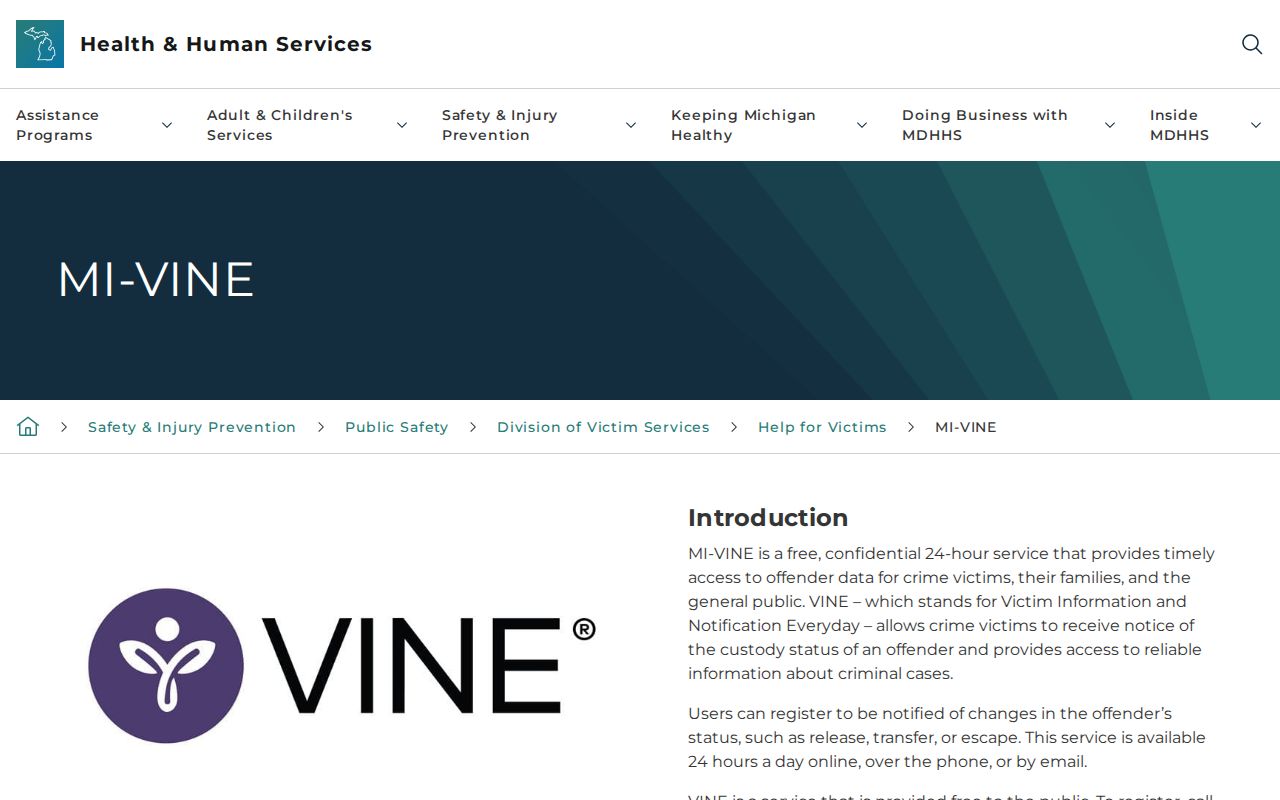
The statewide service is one layer. Eligible state-prison victims should complete the additional MDOC registration rather than assume the VINELink watch supplies every statutory notice.
Confirm Ontonagon VINELink Releases
For a reported Ontonagon County Jail release, call the Sheriff at 906-884-4901. Ask whether the person is currently housed and, if not, whether the last event was release to the community, bond, sentence completion, transfer, hospitalization, or pickup by another agency. When the phone response is limited, request the booking and release record from the Sheriff at 620 Conglomerate, Ontonagon, MI 49953. Public counter hours are not published, so call before traveling.
Then use MiCOURT Case Search to find the legal event. The 98th District Court covers misdemeanors and early felony proceedings, while the 32nd Circuit Court handles felony adjudication and sentencing. A bond order can explain why someone left jail while the case stays open. A court file is more durable than a time-sensitive alert.
If the person entered state custody, check MDOC OTIS. “Date Paroled” identifies actual prison departure or acquisition of parole status. “Earliest Release Date” is a parole-eligibility point, not a promise. A “Prisoner” status still means custody even when an earliest date is displayed, while “Discharged” means MDOC jurisdiction has ended.
OTIS remains public for people currently under MDOC supervision and for many discharged records during the three years after supervision discharge. It excludes county-jail prisoners, city lockups, and jail-only sentences. That boundary explains why an Ontonagon County Jail name may appear in MI-VINE but not in OTIS. If a state discharge is older than the OTIS display period, use the sentencing-court file or request the specific MDOC discharge record instead of reading the missing result as proof about present custody.
Ontonagon VINELink Release Limits
VINELink does not provide the authoritative federal release record. For a federally sentenced person, use the BOP Inmate Locator. BOP can show a current facility or “Released” with a date for covered records. Federal supervised release belongs to the federal court and U.S. Probation system, not MDOC parole.
MI-VINE also cannot prove that no other hold exists. An event may be delayed, a record may use a different spelling, and a participating agency controls the data it sends. No result can reflect an alias, a system mismatch, or custody outside the selected service. The Michigan Public Sex Offender Registry is separate and covers only qualifying registrants; it is not a substitute for release status.
A changed phone number or email address creates another practical limit. Update each registration as soon as contact details change. For calls, keep the four-digit PIN where the intended recipient can reach it, but do not disclose it with the search record. Operators are available around the clock through the MI-VINE line when a registration or acknowledgment problem prevents the alert from working as planned.
For an immigration handoff, use ICE’s Online Detainee Locator after the Sheriff confirms an ICE transfer. No official source reviewed establishes an ICE detention facility or county ICE contract in Ontonagon County. Federal and immigration tools are conditional routes, not the default jail check.
MI-VINE’s own safety guidance warns against relying on one alert alone. The same rule supports accurate custody verification. Record the source, time, exact status language, and identity fields. Then confirm the outcome with the office that created the custody event.