
Ontonagon Parole Versus Probation
Parole follows release from an MDOC prison. The Michigan Parole Board authorizes that release, and the Field Operations Administration supervises the person in the community. The prison term has not vanished. Conditions remain in force until the person is discharged from the applicable sentence. Probation is a community sentence ordered by a court. A felony probationer may be supervised by MDOC even if that person never entered state prison. Local District Court probation can also exist, but it is not the same office or record path as MDOC parole.
The distinction controls where to verify the record. OTIS can show prisoners, parolees, and felony probationers under MDOC supervision, plus people discharged within the display period. A court file explains the sentence that created probation. Neither a current parole label nor a probation label proves that all other cases have ended.
| Point | Parole | Probation |
|---|---|---|
| How it begins | Release from MDOC prison after Board action and processing | Court orders a community sentence |
| Who supervises | MDOC Field Operations Administration | MDOC for felony probation, or the local court in a county matter |
| Best public check | OTIS status, Date Paroled, and supervision location | OTIS for MDOC probation; MiCOURT and the sentencing court for the order |
| How it ends | MDOC discharge or other lawful termination | Court or MDOC discharge from probation |
- Parole
- Release from prison into community supervision before the maximum sentence ends.
- Probation
- A court-ordered sentence served in the community, sometimes after a jail term.
- Discharge
- The end of the stated MDOC custody or supervision authority.
- Absconder
- An official supervision status reporting noncompliance or unknown whereabouts, not a new conviction by itself.
Verify Ontonagon Post-Release Supervision
Start with the custody system that imposed supervision. An Ontonagon County Jail release does not by itself create MDOC parole. OTIS applies when a person received an MDOC prison sentence, state parole, or felony probation. A jail-only sentence is excluded. Search by MDOC number when known because a number is less prone to a false match than a name.
- Open the OTIS offender search. Enter the MDOC number, or use the exact first and last name.
- Compare date of birth, aliases, physical details, sentencing county, court number, and offense before selecting a record.
- Read the exact status. “Parole” shows release from prison into supervision. “Probation” shows a community order, while “Discharged” shows MDOC jurisdiction has ended.
- Check the listed location or supervision location. If Ontonagon appears, compare it with the official Region 1 directory.
- Use MiCOURT or the sentencing court when probation is court-run, when the judgment seems wrong, or when a jail-only sentence is involved.
OTIS keeps routine discharged records visible for three years after supervision discharge. An older discharge may therefore require the sentencing-court file or an MDOC records request. A person who is absent from OTIS may also have a jail-only case, a spelling variation, or a record affected by a lawful set-aside.
For the broader county release path, the Ontonagon County released inmate search explains how the Sheriff record, MI-VINE event, court docket, and OTIS record answer different questions.
Ontonagon Parole Office Details
Ontonagon has a local MDOC field office even though no state prison now operates in the county. The office is the correct contact after OTIS identifies Ontonagon as the supervision location. Staff can clarify public status or route a correction, but may withhold private case-management details. An office assignment is not a home address and should never be described as one.
Ontonagon County Parole/Probation Office
725 Greenland Road
Ontonagon, MI 49953
Phone: 906-281-0035
Hours: Not published in the research; call before visiting.
The MDOC Region 1 directory is the source for this listing. Its captured Ontonagon entry shows the local point of contact:
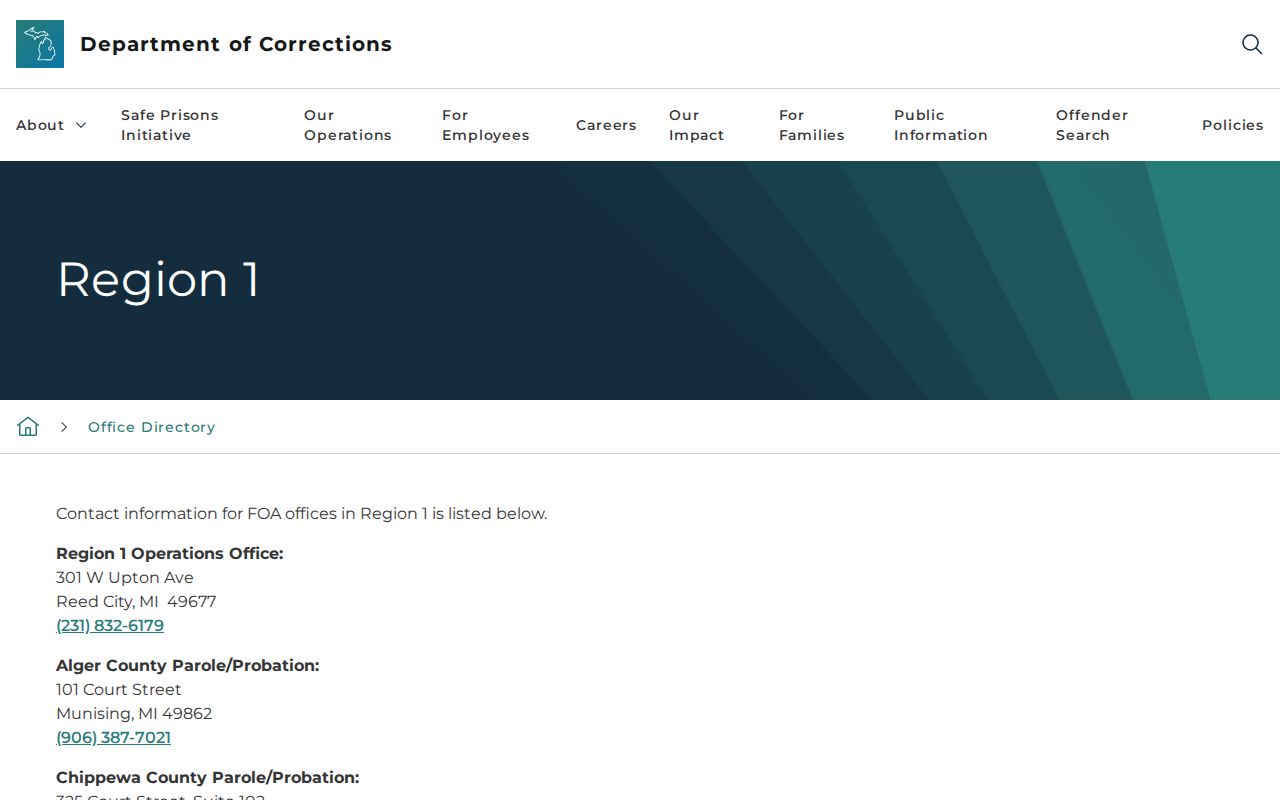
The directory image helps confirm the office, while OTIS remains the first place to establish that the person is actually assigned there.
Ontonagon Supervision Status Changes
Parole and probation conditions are person-specific. They can address reporting, travel, approved residence, treatment, testing, contact, or payment duties as set by the lawful order and supervising authority. A missed condition does not let a reader decide the legal outcome. The agent, court, Parole Board, and other authorized officials determine the response. Depending on the case, a violation may lead to added direction, a hearing, a warrant, or return to custody.
An OTIS “absconder” label should be repeated only with its source and current date. It reports that supervision regards the person as noncompliant or their whereabouts as unknown. It is not a new conviction. Ontonagon County does not publish a verified sheriff absconder or warrant list in the researched channel. Use the current OTIS record and the listed supervision office, not an old repost or image.
MI-VINE serves a different role. It can send custody and court-event notices for participating county systems, but it is not the source for all parole supervision changes. A crime victim who needs expanded state-prison notice of parole eligibility, hearings, decisions, transfers, and release must also register with MDOC Crime Victims Services. A general county-jail watch should not be mistaken for that state-prison registration.
Ending Ontonagon Parole or Probation
Supervision ends through an official discharge, court order, sentence completion, or another lawful action. Do not infer discharge because a person has stopped reporting to a known office or because a projected date passed. For an MDOC case, read the discharge date and reason in OTIS when available. “Date Paroled” confirms the prison release event, but parole continues afterward. “Maximum Discharge Date” is a sentence endpoint field, subject to lawful calculation and any other sentence or hold.
A felony probation record may end with an MDOC discharge, while local court probation is resolved through the sentencing court’s register of actions and orders. The 98th District Court handles misdemeanors and early felony stages; the 32nd Circuit Court handles felony adjudication and sentencing. Select the right Ontonagon court in MiCOURT. If the record is older or incomplete, ask the clerk for the judgment, later orders, and register of actions.
Note: A release from prison can start parole, but only a later official discharge establishes that MDOC supervision has ended.
Correct Ontonagon Supervision Records
OTIS has a defined correction route, which matters when a public status conflicts with a court order or current supervision facts. Court-derived data comes largely from the sentencing court. A wrong conviction, sentence, or case detail should first be raised with that court. The court can direct MDOC to update the public record after it corrects the source information.
A disputed supervision fact follows another path. Questions about an absconder label, assigned office, or other supervision status should go to the parole or probation office shown in OTIS. For an Ontonagon assignment, that is the Greenland Road office. MDOC also lists its public-information correction guidance and the email correctionsinfo@michigan.gov for inaccurate, outdated, or incomplete public information. Provide the MDOC number, the exact field at issue, and the source order when available.
Note: A correction request should identify the precise field and source record; it should not rely on a name match alone.
Ontonagon Parole Board Decisions
The Michigan Parole Board is the sole paroling authority for felony offenders committed to MDOC. Reaching the Earliest Release Date generally means the Board has jurisdiction to consider parole on an indeterminate sentence. It does not compel release. Under MCL 791.233, the decision uses a reasonable-assurance standard tied to public safety and the facts of the case.
The MDOC parole consideration process explains the review that precedes a decision:
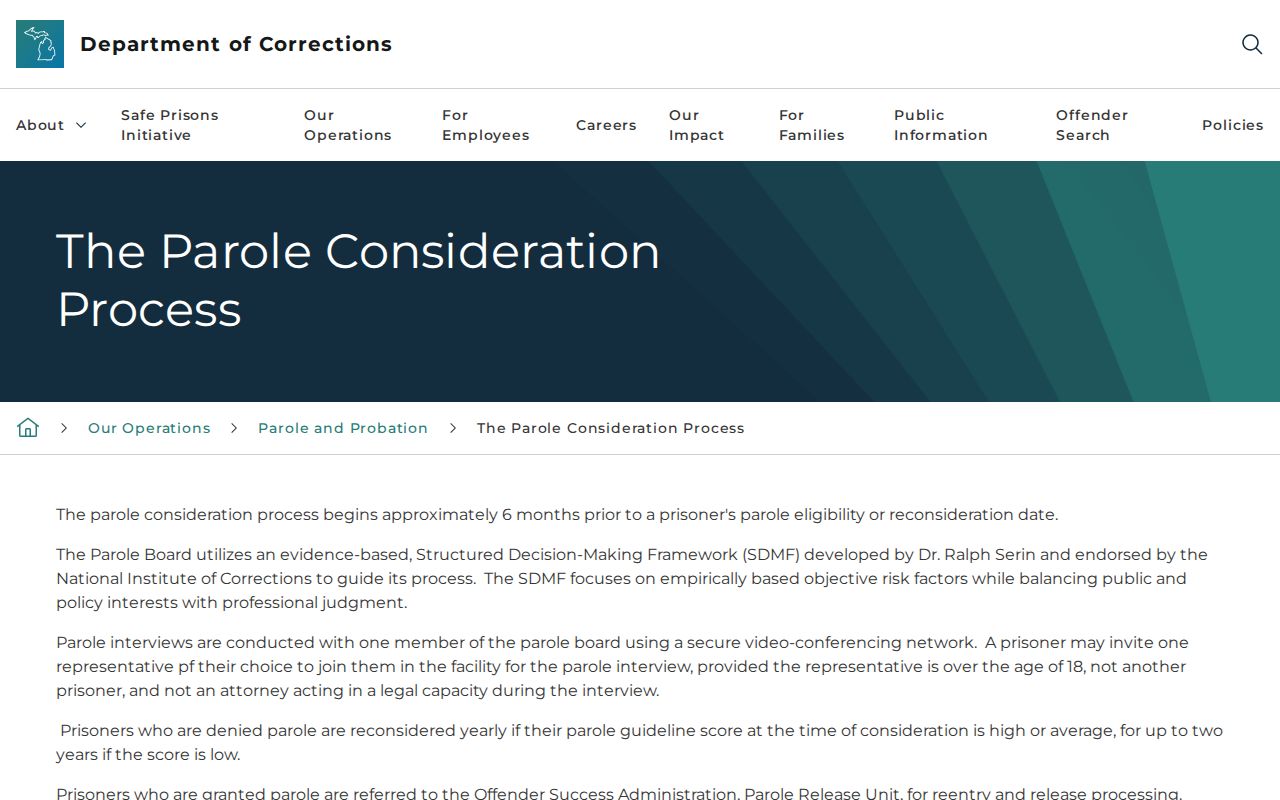
The process image is useful context, but the current OTIS status and Date Paroled are stronger evidence that release actually occurred. Not every ordinary parole interview is public. Public hearing pages chiefly concern statutorily public clemency matters and are not a countywide list of parole decisions.
A grant still precedes release processing. Placement requirements, conditions, another sentence, or a hold can delay or prevent the person from leaving prison on the expected day. A denied or deferred action means there is no release at that review. A rescinded action means a prior grant or step was withdrawn. For a person who has actually left prison, OTIS should be checked for “Parole” and Date Paroled rather than relying on a hearing notice.
The Board’s public hearing registration page is event-driven. Its notices chiefly cover pardons and commutations that require a public process, and the dated press-release archive can be searched by name or MDOC number. A clemency hearing is not a standard Ontonagon parole calendar. In a commutation matter, the Board makes a recommendation and the Governor decides the final disposition.
Board questions can be directed to 517-373-0270 or Parole-Board-Staff@michigan.gov. Use that channel for the Board process, not to replace the local field office that handles a listed Ontonagon supervision assignment.
When the public record is unclear, note the date checked and preserve the exact official label. A later OTIS update can change the answer.