
MDOC Release and Discharge
The Michigan Department of Corrections manages state prisoners, parolees, and felony probationers. It is separate from Ontonagon County Jail. An Ontonagon felony sentence can place a person anywhere in the MDOC system, based on department assignment. The sentencing county does not imply that the prison is in the county. A live prison location means the person remains incarcerated even if a future date appears.
Parole is an actual release from secure prison into community supervision. It is not discharge. A prisoner who is not paroled may remain through the controlling maximum term and then discharge. A parolee can later discharge when MDOC supervision ends. These stages create different status fields, dates, and contact paths.
| OTIS status | Release meaning |
|---|---|
| Prisoner | Still in an MDOC facility; an earliest date is not an actual release. |
| Parolee | Physically out of prison but still under MDOC supervision. |
| Probationer | Serving a community sentence and not necessarily released from prison. |
| Discharged | The applicable MDOC jurisdiction has ended. |
| Absconder | Supervision reports noncompliance or unknown whereabouts, not discharge. |
Search MDOC Ontonagon Releases
OTIS is the principal public search for an Ontonagon County case that produced state prison, parole, or felony probation. MDOC says it includes people currently under its jurisdiction and discharges within three years. It excludes county-jail and city-lockup prisoners, jail-only sentences, some exempt data, and people discharged beyond that display period.
- Use the MDOC number when known because it is more precise than a name.
- Otherwise enter the exact surname and first name, then narrow by age, sex, race, or status only when needed.
- Open a candidate and compare birth date, aliases, physical description, sentencing county, case number, and offense.
- Read current status and location before interpreting any date.
- For actual prison release, look for Date Paroled. For completed jurisdiction, look for discharge date and reason.
The MDOC OTIS information page documents the search system and its coverage:
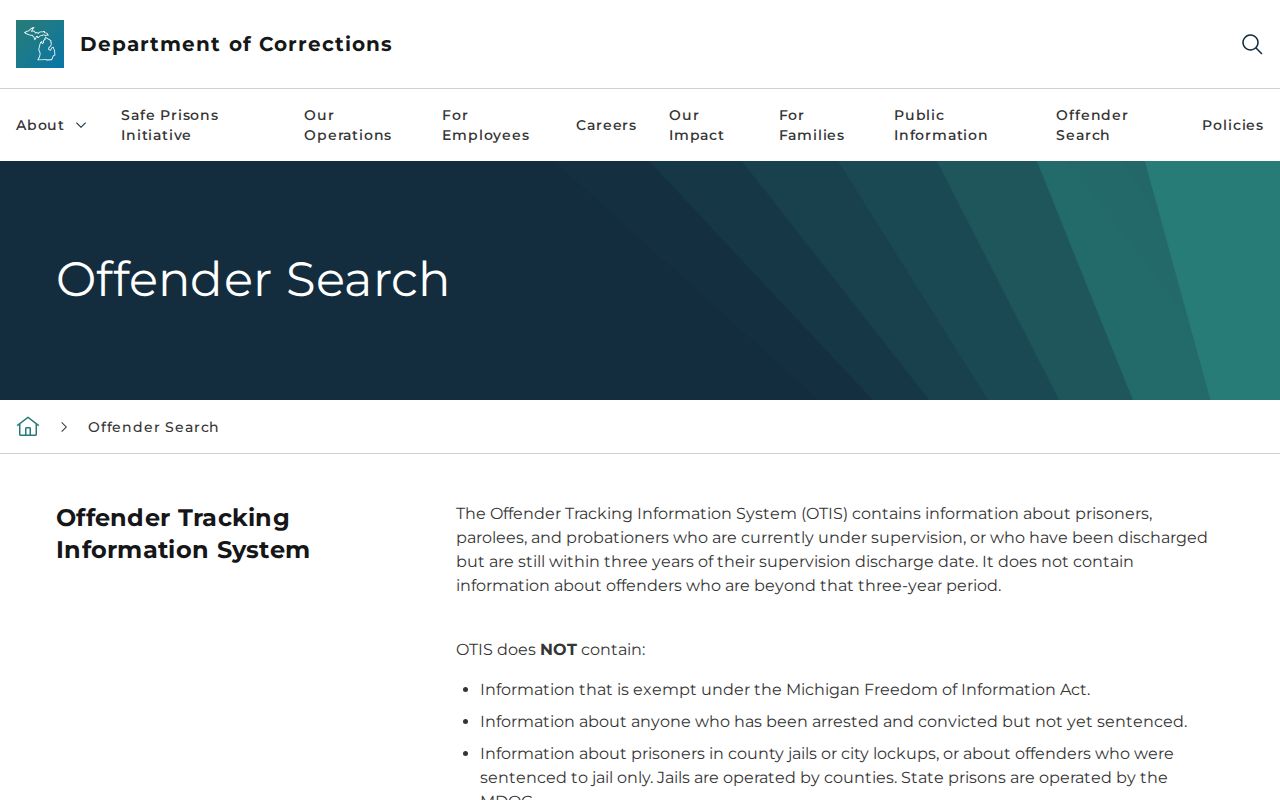
The image identifies the state system. It must not be used as a substitute for the person-specific status and date fields in a matching OTIS record.
A name match is not enough. Preserve the exact field labels and compare the public record with the sentencing-court file. The broader Ontonagon County release search explains when a sheriff record or court disposition is the right source instead.
MDOC Ontonagon Date Fields
Michigan does not use one universal public field called projected release date. OTIS records may show Earliest Release Date, Maximum Discharge Date, Date Paroled, and a discharge date or reason. Each answers a different question. Michigan commonly uses an indeterminate sentence with a minimum and maximum term. The earliest date generally marks when the Parole Board first obtains jurisdiction. It does not compel a grant.
Date Paroled is the actual event field. MDOC explains it as the date the person left prison or camp, or acquired parolee status while under another form of supervision. Maximum Discharge Date is the point at which MDOC cannot keep the person imprisoned on that sentence, subject to lawful calculation and any other sentence or hold.
| Field | Read it as |
|---|---|
| Earliest Release Date | First parole-jurisdiction point, not a promise. |
| Date Paroled | Actual departure from prison or start of parolee status. |
| Maximum Discharge Date | End of authority to imprison on the controlling sentence. |
| Discharge date/reason | End of the stated MDOC jurisdiction. |
Michigan truth in sentencing requires covered prisoners to serve the full minimum before parole consideration. It is not a generic 85-percent rule. Offense dates and sentence categories matter, so calculations should come from MDOC and the judgment.
MDOC Release Record Access
OTIS is the first public contact point, not a complete permanent archive. Its information page explains coverage and correction routes. The live search lists 517-335-1426 for assistance or accommodation. Public-data concerns may be sent to correctionsinfo@michigan.gov. No single local prison contact applies because MDOC may house an Ontonagon County prisoner anywhere in its system.
Statewide prison and supervision system
OTIS assistance: 517-335-1426
Data concerns: correctionsinfo@michigan.gov
Use the official directory for the listed location.
For a record that OTIS does not supply, use the MDOC FOIA process. Identify the MDOC number, full name, date range, Ontonagon sentencing case, and the exact item sought. A discharge certificate, public time-computation fields, parole order, or offender image is more precise than “all records.” Some PENPACK components are restricted, and the departmental FAQ does not promise public access to each part.
Correct MDOC Record Errors
Correction depends on the source of the disputed field. MDOC says court-derived errors should go to the sentencing court. A wrong conviction, court file number, or sentence starts with the 32nd Circuit Court record. An error in supervision information, such as an absconder status or office assignment, should go to the listed parole or probation office. MDOC can update public information when directed by the court or agent.
Capture the OTIS record before calling. Note the MDOC number, exact status, field, and date viewed. Then present the source document that conflicts with it. A set-aside order can change public visibility. Routine discharge, by contrast, generally remains within OTIS for the stated three-year post-discharge display window.
Note: OTIS is updated public information, while a discharge certificate and certified court record are stronger long-term documents.
MDOC Search Coverage Limits
OTIS does not include people held only in Ontonagon County Jail, city lockups, or jail-only sentences. It can also omit a person convicted but not yet sentenced, exempt information, and a discharge older than three years. A no-result therefore does not prove that a person never served an MDOC sentence or that a county detainee was released.
When a record has aged out, use the sentencing-court file or request the MDOC discharge record. When the sheriff says a person was transferred to MDOC but OTIS has not yet resolved the location, compare identifiers and check again with the responsible offices. A prison transfer is not release.
Ojibway Is Not Active
Ontonagon County has no active state prison. MDOC announced that Ojibway Correctional Facility in Marenisco Township would close in December 2018. Old directories can still rank for the former institution and create the false impression that an Ontonagon County state prisoner is housed or released there today. Do not send a visitor, record request, or release inquiry to the closed prison.
Search a former Ojibway prisoner through statewide OTIS. If the person is still in custody, the current facility field is the relevant location. If the record shows parole, use Date Paroled and the listed supervision office. If it shows discharge, preserve the discharge date and reason. Historical institution records remain MDOC records.
Verify MDOC Ontonagon Records
Read status before dates. Confirm identity before status. Then compare the OTIS chronology with the Ontonagon judgment. A parolee is released from prison but supervised. A discharged person has ended the applicable MDOC jurisdiction. A prisoner remains incarcerated. A probationer may never have entered prison.
MI-VINE can add notifications, but expanded state-prison victim notices require separate registration with MDOC Crime Victims Services. The county sheriff is authoritative only for a local jail event. Keeping those systems apart prevents an early eligibility date, prison transfer, or county release from being mislabeled as an MDOC discharge.
Request MDOC Discharge Proof
A focused MDOC request should identify the person by full name and MDOC number, give the Ontonagon sentencing county and case when known, set a useful date range, and name the exact item. A discharge certificate answers whether MDOC jurisdiction ended. A parole order documents the supervision decision. Public time-computation fields help explain the date chronology. A photograph may help match identity, but it does not itself prove release.
MDOC describes a PENPACK for paroled or discharged offenders that can include a basic information sheet, judgment, offender image, fingerprints, reports, and discharge certificate. Some parts contain restricted information, and the published description is not a promise of full public release. Request the smallest public record that answers the question.
For an Ontonagon sentence, compare the MDOC document with the 32nd Circuit Court judgment. The court supplies sentence authority. MDOC supplies prison administration, parole, supervision, and discharge. If the two appear inconsistent, direct the disputed field to the office that created it rather than asking one agency to rewrite the other’s source record.